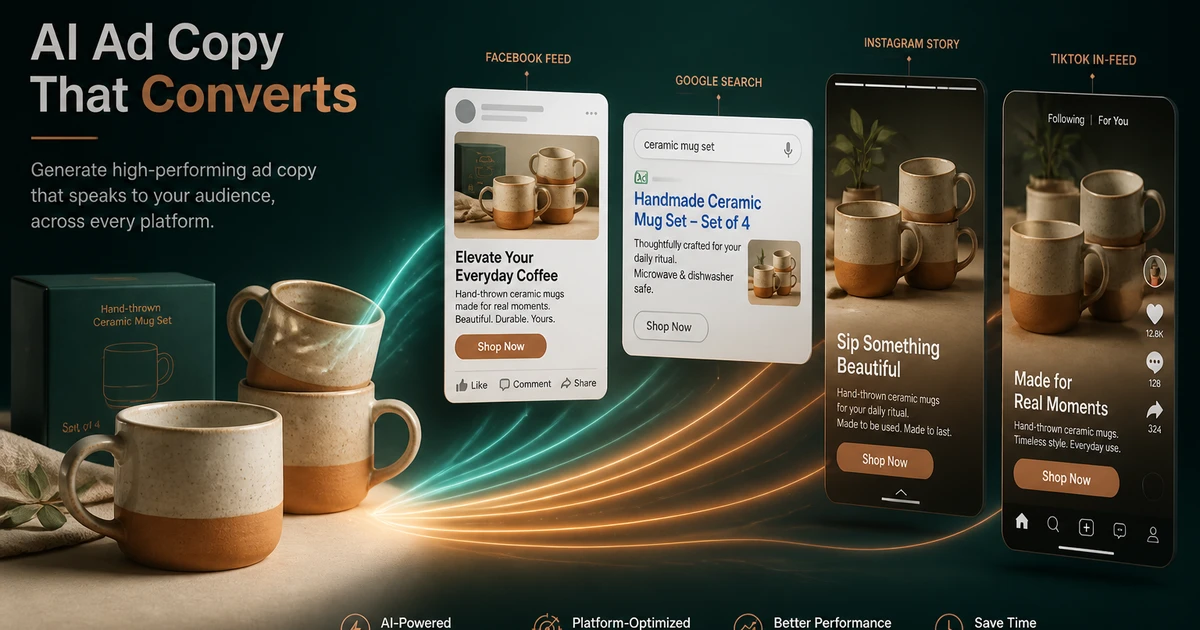
Tell it what you are selling, where the ad will run, and who should see it. You get several copy variations you can paste straight into Meta Ads Manager, Google Ads, or TikTok Ads — no blank-field paralysis, no rewriting the same idea for four different formats.
What you get
- Facebook, Google, Instagram & TikTok formats
- Headlines, primary text & CTAs
- Copy tuned to your campaign goal
- Audience-aware tone and angle
- Brand voice and tone controls
- No copywriting experience needed
What Is an Ad Copy Generator?
An ad copy generator is a tool that writes the text of a paid advertisement — the headline, the body, and the call to action — from a few inputs about your product and campaign. Instead of starting from an empty text field in Ads Manager, you describe what you are selling once and receive several ready-to-test variations.
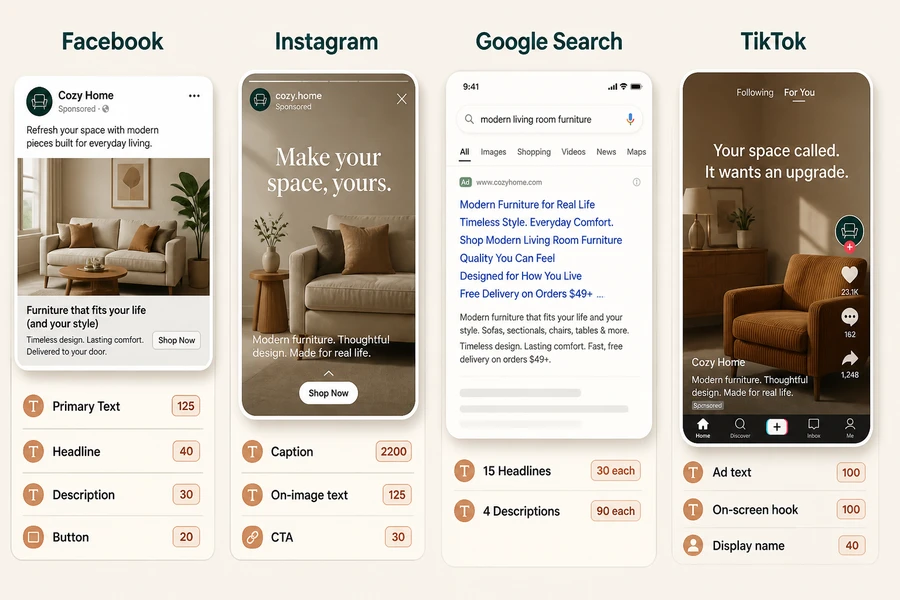
Ad copy is not one thing. A single Facebook ad contains a primary text block, a headline, a description, and a button label. A Google search ad is a stack of short headlines and descriptions. TikTok and Instagram ads lean on a caption and an on-screen hook. Good ad copy generators understand these building blocks, so the output fits the placement instead of reading like a generic paragraph.
What separates strong ad copy from filler is not clever wordplay — it is alignment. The right copy matches the platform’s format, speaks to the audience’s mindset, leads with one clear benefit, and ends with an obvious next step. A generator is a drafting partner: it gets you to a working version in seconds so you can spend your time testing angles and reading results.
This tool handles ad copy. For the product pages and listings those ads send traffic to, use the Product Description Generator. If your campaigns run on organic social instead of paid, the Social Media Caption Generator covers captions, hashtags, and alt text.
One Tool, Four Ad Platforms
Each platform gives you different amounts of space and rewards a different tone. The generator adapts its output to the placement you choose.
| Platform | Copy fields | Typical limits | What performs |
|---|---|---|---|
| Primary text, headline, description, button | Primary ~125 visible; headline ~27–40 | Benefit-led hooks, social proof, clear offers | |
| Caption, on-image text, CTA sticker/button | Caption up to 2,200; first ~125 visible | Visual-first hooks, lifestyle tone, light hashtags | |
| Google Search | 15 headlines, 4 descriptions | Headlines up to 30; descriptions up to 90 | Keyword-matched headlines, benefit + offer |
| TikTok | Ad text/caption, on-screen hook, display name | Short and vertical (~100 or less) | Native, spoken-style hooks, emotion and speed |
Facebook. Facebook feed ads live or die by the first line of the primary text. The generator writes a hook that earns the “see more” click, then supports it with a benefit and a reason to act now. It also produces the short headline that sits under the creative.
Instagram. Instagram copy is image-first, so the words support the visual. Expect a strong opening line, a scannable middle, a soft CTA, and a small set of relevant hashtags rather than a wall of them.
Google Search. Search ads meet active intent, so the copy leads with the search phrase and the promised outcome. The generator fills the headline and description slots with keyword-aware options and keeps them inside the character limits, so nothing truncates.
TikTok. TikTok rewards native, spoken-language hooks that feel like a creator’s voice, not a brand announcement. The generator writes punchy, vertical-friendly lines and a display name that reads clean on a phone.
Match Copy to Your Campaign Goal
The same product needs different words depending on what the campaign is optimizing for. The generator lets you set the goal, and the copy shifts accordingly.
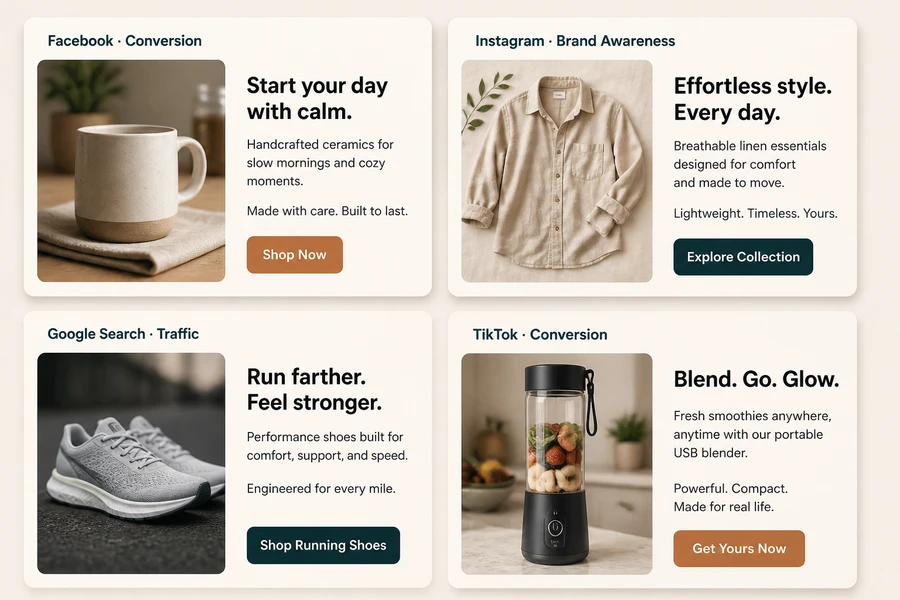
Conversion. Conversion copy drives one action: buy, sign up, add to cart. It leads with the offer or the core benefit, removes friction, creates a light sense of urgency, and ends with a direct command. “Get 20% off your first order — shop the collection today.”
Traffic. Traffic copy earns a click, not a sale. It leans on curiosity, a clear promise, and a specific destination. “See 12 ways to style this linen shirt — read the guide.” The job is to make the next step feel low-risk and interesting.
Brand awareness. Awareness copy builds memory, not a click. It uses a distinctive voice, communicates what the brand stands for, and repeats one ownable idea. “Made for the makers — handcrafted goods for people who care where things come from.” Fewer hard sells, more personality.
Because the tool produces multiple variations, you can run one per goal and let the data decide which angle your audience responds to.
Write for the Audience, Not Just the Platform
Audience targeting and copy are two halves of the same campaign. The words change depending on whether the person seeing your ad already knows you.
- Cold audiences. Assume no prior knowledge. Lead with the problem you solve and the outcome you deliver. Avoid inside language and jargon.
- Warm and retargeting audiences. They have seen you before. Reference their interest, answer the objection that stopped them, and use reviews or guarantees to close the gap.
- Lookalike audiences. They resemble your best customers. Mirror the language and values that already convert, then refine with the results you see.
- Search-intent audiences. On Google, match the exact query. If someone searches “waterproof running shoes,” the headline should say it, not hint at it.
- Interest and demographic audiences. Adjust the benefit you emphasize. The same jacket sells as warmth to one group and as style to another.
For a broader view of how product data, audiences, and channels fit together, see our E-commerce Platform Comparison and Cross-Platform Listing Strategy.
Ad Copy Examples
These examples show how the same generator output adapts to platform, goal, and audience. All are original examples written for illustration.
1. Facebook — conversion — retargeting
Headline: “Still thinking about it? Take 15% off”
Primary text: “Your cart is saved, and the discount is live. Our bestselling ceramic mug set ships free this week — grab yours before the code expires.”
CTA: Shop Now
2. Instagram — brand awareness — cold audience
Caption hook: “Small-batch, hand-thrown, made to be used every morning.”
Body: “Each mug is shaped by hand, so no two are exactly alike. Tag someone who needs a slower morning.”
CTA: Learn More
3. Google Search — traffic — high-intent keywords
Headline: “Waterproof Running Shoes”
Headline 2: “Free 30-Day Returns”
Description: “Lightweight, waterproof running shoes built for wet-weather miles. Free shipping and easy returns.”
CTA: Shop Now
4. TikTok — conversion — cold audience
On-screen hook: “POV: your blender fits in your bag”
Ad text: “The portable blender that actually crushes ice. One charge, ten smoothies. Tap to grab yours.”
CTA: Shop Now
How It Works
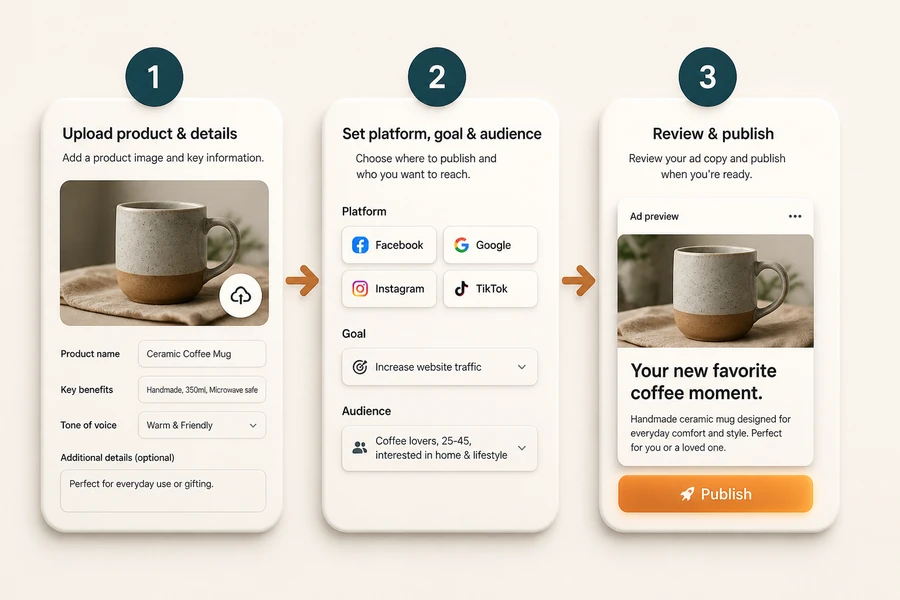
1. Upload and describe your product.
Add a product image and the key details — what it is, the offer, and anything the copy must include. ImageChat reads the visual to ground the wording in the real product.
2. Set platform, goal, and audience.
Choose where the ad runs (Facebook, Google, Instagram, or TikTok), what the campaign is optimizing for (conversion, traffic, or brand awareness), and who should see it. Add your brand voice if you have one.
3. Review, refine, and publish.
You get multiple copy variations per field with the character limits respected. Edit anything, then paste the winner into Ads Manager, Google Ads, or TikTok Ads.
FAQ
What is an ad copy generator?
An ad copy generator is a tool that writes the text of a paid ad — headline, body, and call to action — from a few inputs about your product, platform, campaign goal, and audience. It produces draft variations you can edit and publish, so you start from a working version instead of a blank field.
Which platforms does ImageChat's ad copy generator support?
It writes ad copy for Facebook, Instagram, Google Search, and TikTok. Each output follows that platform’s field structure and typical character limits, so the copy fits the placement rather than reading as one generic block.
Can AI-written ad copy match my brand voice?
Yes. You can describe your brand’s tone and the words or claims you always use, and the generator will follow them. Treat the first output as a draft: a quick edit for your specific offers and phrasing usually makes it fully yours.
Is ad copy different from product listing copy?
Yes. Product listing copy is built to inform and rank on a shopping page. Ad copy is built to stop a scroll and drive one action within seconds. The two support each other.
How many ad copy variations should I test?
Start with three to five distinct angles per campaign rather than minor word tweaks. Test one big idea at a time — different hooks, offers, or audience framing — so you can tell what actually moved performance, then double down on the winner.
Does the copy stay within platform character limits?
Yes. The generator works to each platform’s typical limits — for example, Google headline and description limits and Facebook’s visible primary-text length — so your ads do not truncate. Platform specs change, so confirm the latest limits in that platform’s ad help center before you publish.
Create Your Ad Now
You do not need a copywriter to test more angles. Upload a product photo, choose your platform and goal, and let the Ad Copy Generator turn it into ad text you can paste and publish. Start with a few variations, let the data pick the winner, and repeat.
Create Your Ad Now →Related Resources
- Product Description Generator
- Social Media Caption Generator
- E-commerce Platform Comparison
- Cross-Platform Listing Strategy
- Instagram Caption Best Practices 2026
- Amazon vs Shopify vs Etsy