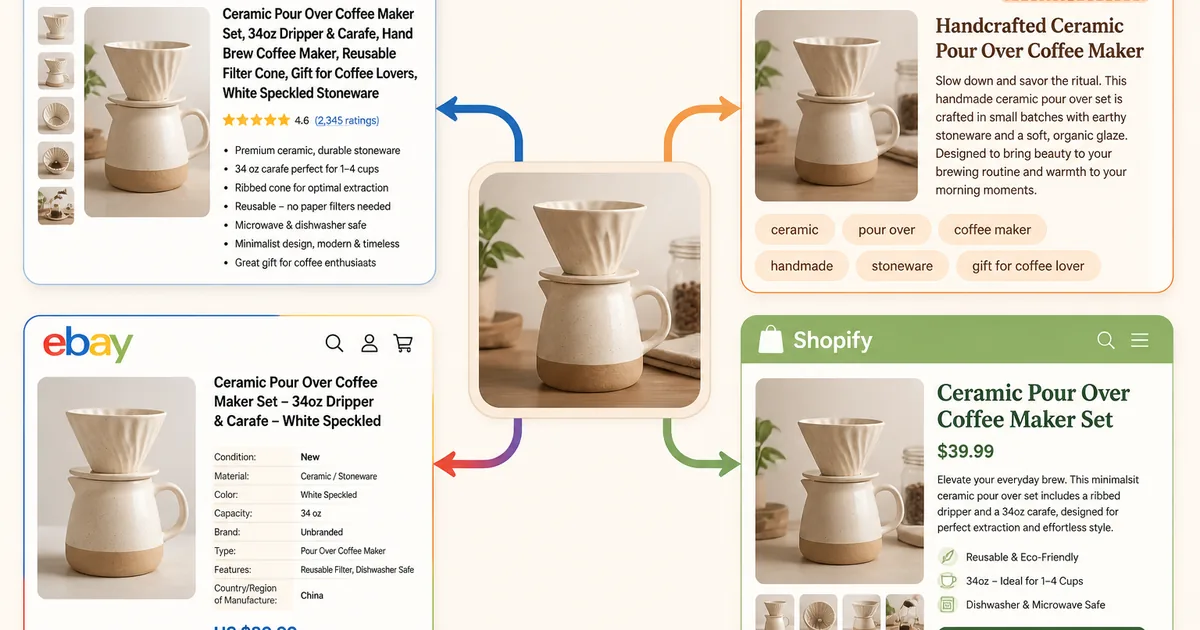
Selling on more than one marketplace multiplies your reach — and your listing workload. Every platform has its own title format, image rules, attribute requirements, and search algorithm.
A cross platform listing strategy is the system you use to create, adapt, and manage product listings across channels without duplicating effort or losing consistency. This guide covers platform differences, a unified workflow, and mistakes that quietly suppress sales.
What Is a Cross-Platform Listing?
A cross-platform listing is a single product listed on multiple sales channels — Amazon, Etsy, eBay, Shopify, or others — with each version tailored to that platform’s format and search rules. The product stays the same; the presentation changes.
Amazon relies on keyword-stuffed titles and backend search terms. Etsy prioritizes tags and storytelling. eBay matches on item specifics. Your Shopify store needs pages optimized for Google. A listing that wins on one platform often underperforms on another if simply copy-pasted.
A good strategy keeps product data consistent, adapts each listing to local ranking factors, and synchronizes inventory so you never oversell. For the broader business case, see our Multi-Platform Selling Strategy guide.
How Listing Requirements Differ Across Platforms
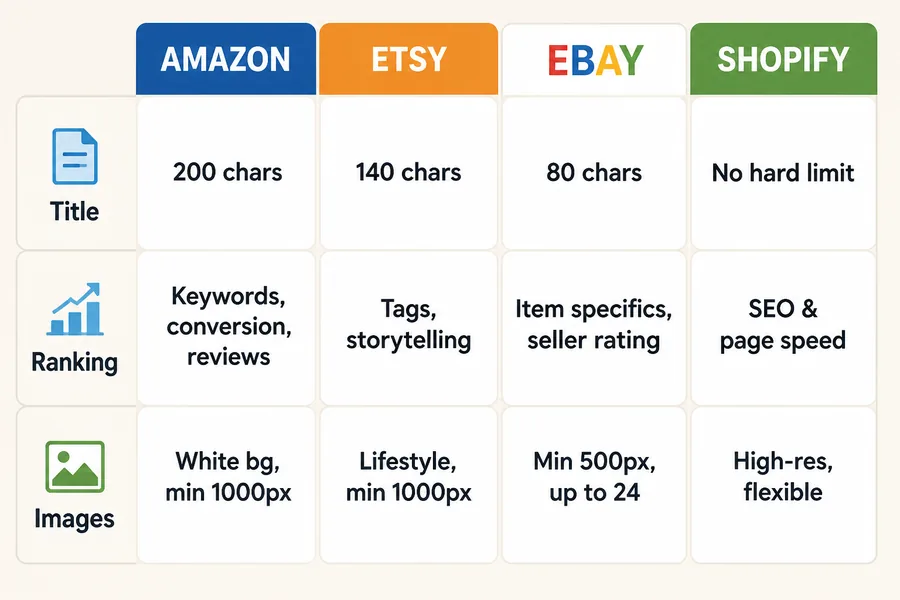
Each marketplace has its own listing anatomy. Understanding these differences is the foundation of cross-platform listing.
| Platform | Title approach | Key ranking factors | Image requirements |
|---|---|---|---|
| Amazon | Front-loaded keywords, 200 char max | Backend keywords, conversion rate, reviews | White background main image, min 1000px |
| Etsy | Readable titles with tags, 140 char max | Tags, shop quality, listing completeness | Lifestyle photos, min 1000px, up to 10 images |
| eBay | Item specifics + title, 80 char max | Item specifics, seller rating, free shipping | Min 500px, up to 24 photos free |
| Shopify | Human + SEO-friendly, no hard limit | Page speed, structured data, Google SEO | High-resolution, lifestyle + product, flexible |
Learn the Amazon-specific approach in our Amazon Listing Optimization Guide, and the Etsy angle in our Etsy Listing Description Guide.
A Unified Cross-Platform Listing Workflow
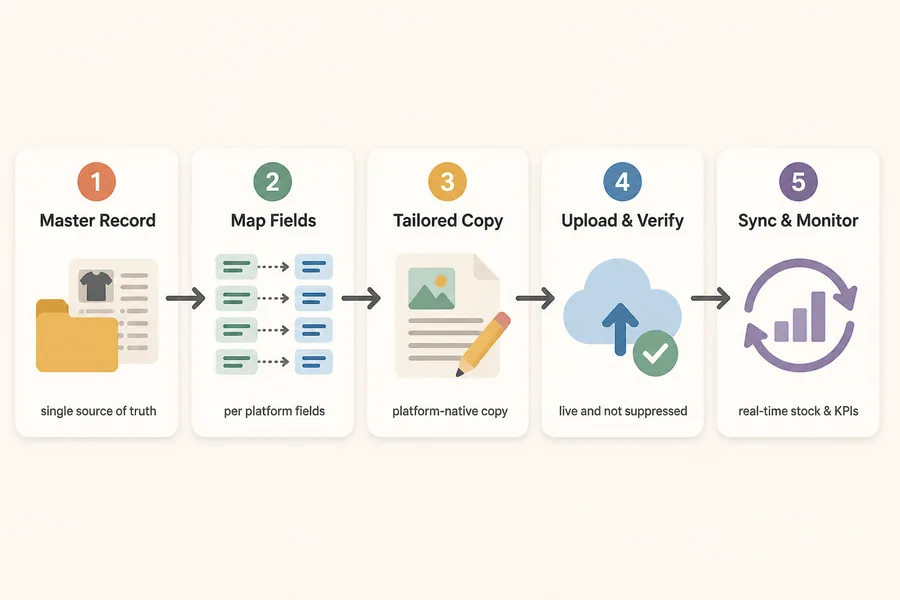
You do not need a different process for every platform. Create once, adapt per channel, and publish with confidence.
Build a master product record
Start with one complete product data set: title, description, bullet points, attributes, and a full image set. This is your single source of truth.
Map fields to each platform
Translate the master record into required fields. Amazon needs backend keywords, Etsy needs 13 tags, eBay wants item specifics, and Shopify wants meta descriptions and alt text.
Generate platform-tailored copy
Tune descriptions to each platform’s buyers and algorithm. ImageChat turns one product photo and a few details into formatted marketplace versions.
Upload and verify
Check that listings are live, images meet resolution requirements, titles fit limits, and required attributes are filled.
Sync inventory and monitor
Connect channels with an inventory sync tool. Monitor impressions, conversion rate, and return rate, then adjust each listing based on its data.
Best Practices for Cross-Platform Listings
- Keep a single source of truth: update one master record and propagate changes.
- Adapt titles, do not copy them: rewrite for each platform’s character limit and audience tone.
- Fill every attribute field so marketplaces can categorize and filter your products.
- Match image specs per channel: Amazon needs a white-background main image; Etsy rewards lifestyle photos.
- Price for channel economics. Compare true margins with our E-commerce Platform Comparison.
- Review listings quarterly because algorithms and requirements change.
Read our E-commerce Platform Comparison before setting channel pricing.
Common Cross-Platform Listing Mistakes
- Copy-pasting one listing everywhere. Each platform ranks differently, so generic copy loses to platform-native competitors.
- Ignoring backend keywords and tags. These invisible fields are critical to search on Amazon and Etsy.
- Using the wrong image format. Match lifestyle and white-background photography to platform expectations.
- Failing to sync inventory. Overselling the last unit causes canceled orders and rating damage.
- Inconsistent product data. Different dimensions or materials confuse buyers and erode trust.
Frequently Asked Questions
What is a cross-platform listing?
A cross-platform listing is a single product listed on multiple sales channels — such as Amazon, Etsy, eBay, and Shopify — with each version adapted to that platform’s title format, image rules, and search algorithm. The product stays the same; the listing presentation changes per channel.
Can I use the same listing on every platform?
You can list the same product everywhere, but you should not use identical listing copy. Each platform ranks and displays listings differently. Amazon rewards keyword-rich titles and backend terms; Etsy responds to tags and story; eBay matches on item specifics. Adapt each listing to the platform’s format for best results.
How do I keep inventory synced across platforms?
Use a multichannel inventory management tool that updates stock levels in real time across all connected marketplaces. Alternatively, allocate separate stock quantities per channel with a safety buffer. The goal is to prevent overselling.
How many images should a cross-platform listing have?
Plan for at least 5–7 images per product: one clean product shot on white background for Amazon, several lifestyle photos for Etsy and Shopify, and detail close-ups. This set covers every platform’s requirements without reshooting per channel.
What is the biggest mistake in cross-platform listing?
Copy-pasting one listing across all platforms. It saves time initially but suppresses visibility on every channel because the listing does not match local ranking factors. Invest in platform-tailored copy from the start.
How does ImageChat help with cross-platform listings?
ImageChat takes one product photo and basic product details, then generates listing copy formatted for Amazon, Etsy, eBay, and Shopify in a single pass. You get platform-tailored titles, descriptions, and bullet points without writing each version manually.
Start Creating Cross-Platform Listings Today
A cross platform listing strategy is not about being everywhere — it is about being correctly present on each channel. Build one master record, adapt it to each platform’s rules, sync inventory, and review performance regularly.
Ready to create every version in one pass?
Turn one product photo and a few details into marketplace-ready copy.
Generate Cross-Platform ListingsRelated Resources
- Multi-Platform Selling Strategy
- Amazon Listing Optimization Guide
- Etsy Listing Description Guide
- Shopify SEO Guide
- E-commerce Platform Comparison
- Product Description Generator