What Is an Electronics Product Description?
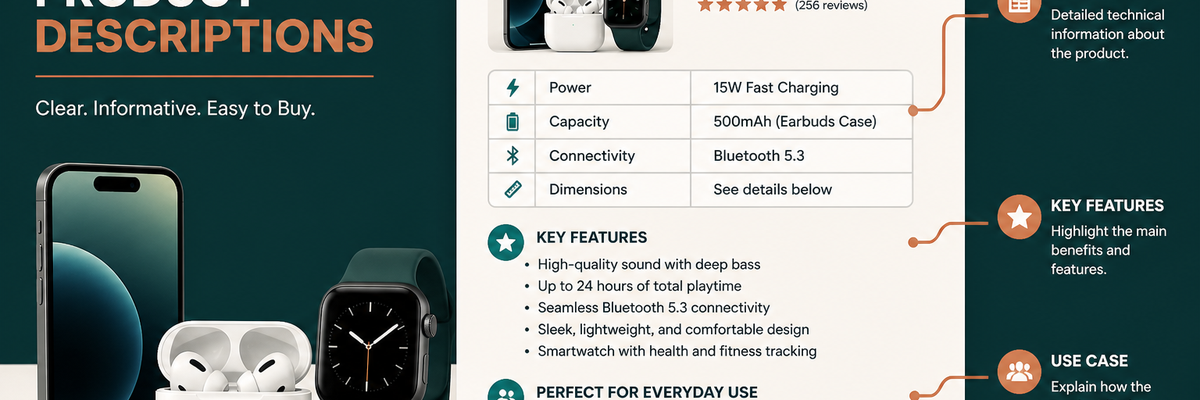
An electronics product description is the written content that explains what a device or accessory does, how it performs, and why a shopper should choose it. Unlike fashion or home goods, electronics descriptions carry a heavier technical load — shoppers need precise specifications, compatibility details, and performance claims they can verify before buying.
A complete electronics description typically includes:
- • Product name and category identifier
- • Key specifications (power output, capacity, dimensions, weight, connectivity standards)
- • Features translated into real-world benefits
- • Use cases showing the product in action
- • Compatibility and system requirements
- • Package contents (what is in the box)
- • Warranty and support information
The description serves two audiences at once. The search algorithm on Amazon, Shopify, or Etsy scans it for keywords, structure, and completeness. The human shopper reads it for clarity, confidence, and the answer to one question: will this work for what I need? A description that serves only the algorithm reads like a keyword list. One that serves only the human may never get found. The best descriptions serve both.
Electronics descriptions also scale with product complexity. A USB-C charging cable needs a short, spec-forward description — shoppers want to confirm wattage and connector type, then buy. A smart home security camera needs use-case storytelling, setup guidance, and a compatibility matrix. Match the depth of your description to the complexity of the product and the questions your shopper is most likely to ask before clicking add to cart.
Why Electronics Descriptions Matter
Electronics has one of the highest return rates in e-commerce. According to the National Retail Federation, the consumer electronics category consistently sees return rates between 15% and 30%, far exceeding the 8–10% average across all retail categories. The leading causes — product did not match description and compatibility issues — are directly fixable through better copy.
When a description is vague or incomplete, three things happen in sequence. First, conversion drops: shoppers who cannot confirm that a device meets their needs will abandon the listing. Second, returns rise: shoppers who buy based on assumptions and receive something different will send it back. Third, reviews suffer: disappointed buyers leave negative feedback that suppresses future conversions and erodes your listing’s search ranking.
A strong description creates a virtuous cycle instead. Precise specifications filter out shoppers who need a different product — they leave your page rather than buy and return. Clear use cases help the right shopper picture the product in their daily life, increasing the likelihood of purchase. And confident buyers who receive what they expected leave positive reviews that compound your listing’s performance over time.
The financial impact is direct and measurable. For a $60 electronics product with a 20% return rate, each return costs roughly $10–15 in reverse logistics, restocking fees, and potential product damage. Reducing returns from 20% to 12% through clearer descriptions saves $1.60–2.40 per unit sold — a margin improvement that requires no additional ad spend or pricing changes.
Beyond returns, description quality drives search visibility. Amazon’s A9 algorithm and Google Search both reward listings with complete, structured, keyword-relevant content. A description that naturally covers specifications, use cases, and compatibility includes the long-tail search terms that electronics shoppers use when looking for specific features like “65W USB-C charger with Power Delivery” or “Bluetooth 5.3 earbuds with ANC.”
How to Write Electronics Product Descriptions
Writing an electronics description that converts is a repeatable process. Follow these eight steps for every product, adjusting the depth of each step to match product complexity.
Step 1: Gather and Organize Specifications
Start by collecting every technical specification from the manufacturer, product team, or supplier. For electronics, this includes power input and output, battery capacity, dimensions, weight, connectivity standards (Bluetooth version, Wi-Fi protocol, USB generation), operating temperature, and any certifications (FCC, CE, RoHS). Organize these into a spec table that shoppers can scan quickly. The goal is completeness — a missing spec is a lost sale or a future return.
Step 2: Translate Features Into Benefits
Every technical feature needs a plain-language benefit alongside it. A shopper reads “65W Power Delivery” and may not know whether that charges their laptop or just their phone. Write: “65W Power Delivery — fully charges a 13-inch laptop in about 90 minutes, or fast-charges a phone in 30.” The feature tells the algorithm what the product is. The benefit tells the shopper why it matters.
Step 3: Write Use-Case Scenarios
Electronics products solve problems, and your description should show those problems being solved. Write 2–3 short scenarios that place the product in a real context. For a portable power bank: “Charge your phone and earbuds simultaneously during a long flight — 20,000mAh holds enough for 4 full phone charges.” For a smart plug: “Schedule your coffee maker to start at 7 AM and your lights to turn off at midnight — no app check-in required once it is set.” Use cases help shoppers self-identify: if they see their problem described, they feel confident the product is for them.
Step 4: Address Compatibility Clearly
Compatibility is the number one reason electronics get returned. State explicitly what devices, operating systems, or standards the product works with — and what it does not work with. “Compatible with iPhone 15/16 series and iPad Pro with USB-C. Not compatible with Lightning-connector devices.” If adapters are needed, say so. If firmware updates are required, mention them. Clarity here prevents both pre-purchase hesitation and post-purchase returns.
Step 5: Include Package Contents
List everything in the box. Shoppers assume accessories are included unless told otherwise. “Includes: 1x power bank, 1x USB-C to USB-C cable (30cm), 1x carrying pouch, user manual.” This prevents the most common customer service complaint — “I thought it came with a wall charger” — and sets accurate expectations before purchase.
Step 6: Add Warranty and Support
Electronics shoppers care about after-sale support. State the warranty period, what it covers, and how to claim it. “12-month manufacturer warranty covering defects in materials and workmanship. Contact support@example.com for claims.” This builds trust and reduces pre-purchase anxiety, especially for higher-priced items where the buyer wants reassurance that their investment is protected.
Step 7: Adapt for Each Platform
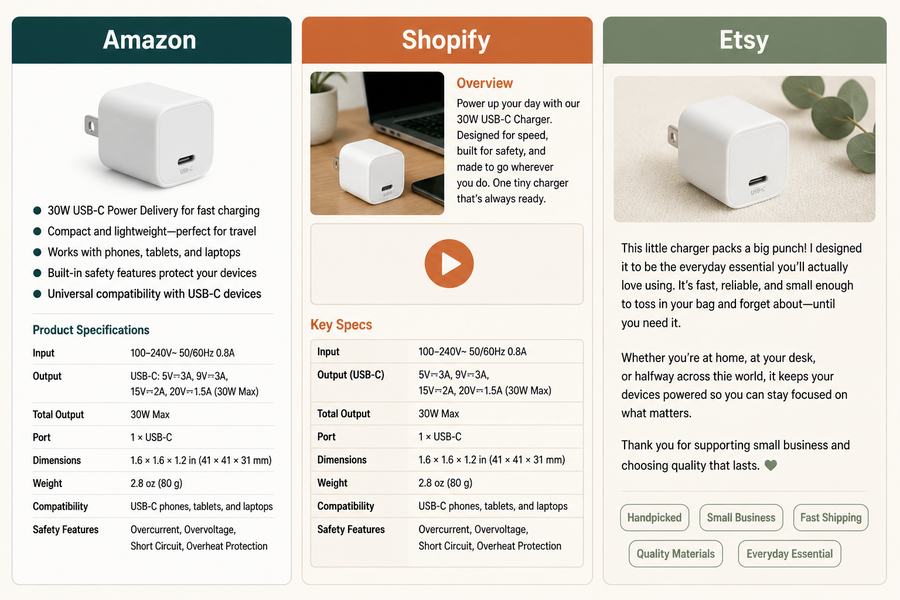
The core information stays the same, but the format changes. On Amazon, lead with five benefit-first bullet points and keep the description under 2,000 characters. On Shopify, use rich sections with subheadings, embedded video, and a spec table. On Etsy, write conversationally for handmade or DIY electronics kits, and use all 13 tags. See the platform-specific best practices below for detailed guidance.
Step 8: Review Against the Shopper’s Questions
Before publishing, read your description as a first-time shopper and check: Can I tell what this product does? Do I know if it works with my devices? Do I understand the key specs? Do I know what comes in the box? Is there a warranty? If any answer is unclear, revise. The description is complete only when a shopper can make a confident buying decision from the text alone.
Electronics Description Best Practices
These practices apply across platforms and product types. They are the difference between a description that merely informs and one that converts.
Use a Consistent Spec Table Format
Electronics shoppers compare products side by side. A structured spec table — with rows for power, capacity, dimensions, weight, connectivity, and certifications — lets them scan quickly and makes your listing look professional. Place the table after the main description, not buried at the bottom.
Lead With the Primary Use Case
The first sentence of your description should tell the shopper what the product is for. “A 65W GaN charger that powers laptops, phones, and tablets from a single port” is better than “Premium charging solution with advanced technology.” The shopper should know what they are looking at within five seconds.
Write for Both Technical and Non-Technical Readers
Layer your description so both audiences find what they need. Start with plain-language benefits, then provide detailed specs in a table or list. A technically savvy shopper will scan to the specs. A non-technical shopper will read the benefits and use cases. Both should leave satisfied.
Include Dimensions and Weight
These are the most commonly omitted specs in electronics listings, and the most common source of “not what I expected” returns. State dimensions in both metric and imperial units. For products where size matters for fitting into a bag, pocket, or mounting space, include a visual size reference in the images.
Test Your Description on Someone Unfamiliar With the Product
Before publishing, ask a friend or colleague who does not know the product to read your description and tell you what it does, who it is for, and whether they would buy it. If they hesitate or ask follow-up questions, your description has gaps. Revise until the text answers every question on its own.
Update Descriptions When Specs Change
Electronics products get revised — new chipsets, updated firmware, changed accessories. When a product changes, update the description immediately. Selling against an outdated description is a return waiting to happen. Review descriptions quarterly even if nothing has changed, to catch accuracy drift.
Platform-Specific Adaptation
The core product information stays the same across marketplaces, but the format, length, and emphasis change. Here is how to adapt a single electronics description for Amazon, Shopify, and Etsy.
Amazon Electronics Descriptions
Title:Amazon allows up to 200 characters for electronics titles. Lead with brand, product type, and the most critical specs (wattage, capacity, model number). Example: “BrandName 65W GaN USB-C Charger — 3-Port, PD 3.0, Compatible with MacBook, iPhone, iPad.”
Bullet points: You get five bullets. For electronics, prioritize: key spec or performance claim, compatibility, build quality or safety certification, use case, and what is included. Each bullet leads with a benefit, then backs it with the technical detail.
Description text:Keep it under 2,000 characters. Use paragraphs and a simple spec list. Avoid subjective superlatives like “best-in-class” — Amazon’s guidelines prohibit them. For deeper optimization, see our Amazon title optimization guide.
Shopify Electronics Descriptions
Length and structure:Aim for 200–500 words. Use subheadings to break the description into scannable sections — “Overview,” “Key Specs,” “What is Included,” “Compatibility.” Shoppers on your own site are further along the funnel, so you can focus on depth and confidence-building rather than keyword density.
Visual integration: Shopify lets you embed product video demos, interactive spec tables, and customer reviews in the description. Use this. An electronics description on Shopify should pair text with at least one demo video or annotated product photo showing ports, dimensions, or setup.
SEO:Shopify pulls your description into the page’s meta description by default. Write the first 155 characters as a self-contained summary. For platform-wide SEO strategy, refer to our Shopify SEO guide.
Etsy Electronics Descriptions
Etsy is best for handmade electronics, DIY kits, vintage tech, and maker tools. The tone should feel personal and maker-driven even when you sell at scale.
Tone:Write conversationally. First-person voice works well for maker-sellers: “I designed this PCB kit to be beginner-friendly — no soldering experience required.” If you are a larger brand, use warm third-person but keep it human.
Tags and materials:Etsy’s search relies heavily on tags (13 available) and the materials field. List every component, standard, and use case. “USB-C, PD 3.0, 65W, GaN, charger, laptop, travel, compact” gives Etsy’s algorithm more to match against.
Length:100–300 words is typical. Lead with the story or what makes it unique, then cover the practical specs. For more on Etsy-specific optimization, see our Etsy listing description guide.
Common Electronics Description Mistakes
Even experienced electronics sellers fall into these traps. Each one suppresses conversions or increases returns.
1. Burying the Most Important Spec
Shoppers scan, they do not read. If the wattage, capacity, or compatibility info is in paragraph three, most shoppers will never see it. Put the two or three most decision-critical specs in the first bullet point or the opening sentence.
2. Using Marketing Language Instead of Specs
“Ultra-fast charging” tells the shopper nothing. “Charges iPhone 15 to 50% in 20 minutes” tells them exactly what to expect. Replace every subjective adjective with a measurable claim. If you cannot measure it, do not claim it.
3. Omitting Compatibility Limitations
Many sellers list what their product works with but omit what it does not work with. This leads to returns from shoppers who assumed compatibility. State both: “Works with USB-C devices. Does not support Lightning-connector iPhones.”
4. Copying the Manufacturer’s Generic Description
If you dropship or resell, the manufacturer’s description is likely used by dozens of other sellers. Rewrite it in your own words with your own use cases and benefit translations. Identical descriptions across listings are invisible to search algorithms and indistinguishable to shoppers.
5. Ignoring Mobile Readability
Most electronics shoppers browse on their phones. Long paragraphs become walls of text on a 6-inch screen. Use short paragraphs, bullet points, and spec tables that render cleanly on mobile. If your description is hard to read on a phone, it is losing sales.
Write Electronics Descriptions in Seconds
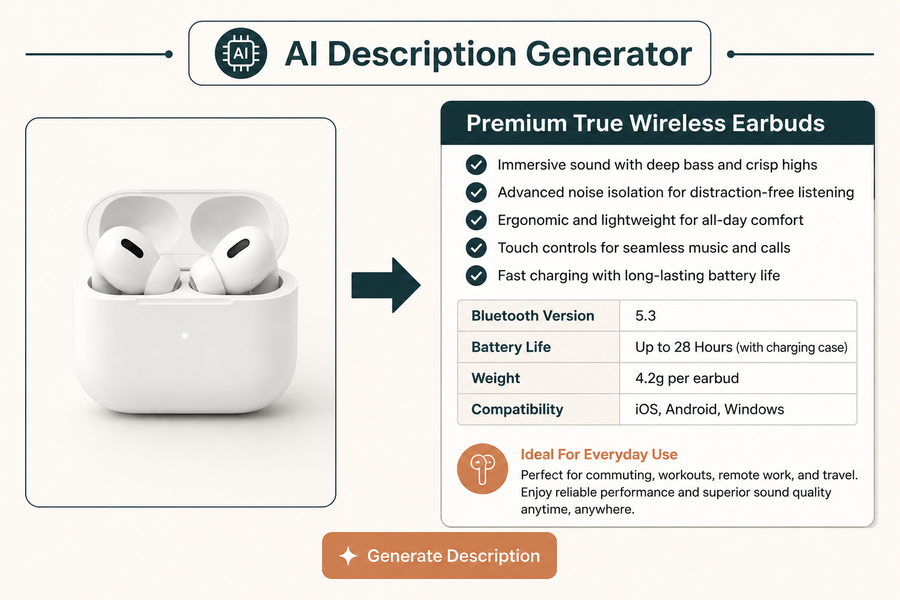
ImageChat’s Product Description Generator turns a product photo and a few specs into a structured draft — title, bullets, use cases, and spec table — ready for you to review and publish.
Generate Electronics Product DescriptionsFrequently Asked Questions
How long should an electronics product description be?
It depends on the platform and product complexity. Amazon descriptions should stay under 2,000 characters. Shopify product pages typically use 200–500 words with structured sections. Etsy listings range from 100–300 words. Simple products like cables need less copy; complex products like smart home devices need more. The goal is completeness, not length — every essential spec and use case should be present without padding.
What specifications should I include in an electronics description?
Include power input and output, battery capacity (if applicable), dimensions, weight, connectivity standards (Bluetooth version, Wi-Fi protocol, USB generation), operating temperature range, certifications (FCC, CE, RoHS), and any product-specific metrics like resolution, refresh rate, or decibel output. When in doubt, include more — a missing spec is a common reason for returns and customer service inquiries.
How do I handle compatibility information?
State explicitly which devices, operating systems, and standards the product works with, and which it does not. Use a dedicated compatibility section rather than burying it in prose. If adapters or firmware updates are required, mention them. For products with broad compatibility, list the standards rather than every device — “USB-C PD 3.0 compatible” covers more ground than listing individual phone models.
Should I write different descriptions for Amazon, Shopify, and Etsy?
Yes. Amazon requires structured bullet points and has strict character limits. Shopify allows rich formatting with subheadings, video, and spec tables. Etsy favors conversational copy for handmade or DIY electronics. Adapt the same core information to each platform’s format and tone. A single description across all three will underperform on at least one.
Can AI write electronics product descriptions?
AI tools like ImageChat’s Product Description Generator can draft structured descriptions from a product photo and basic inputs — including spec tables, bullet points, and use cases. Use the AI output as a starting point, then verify every specification for accuracy, adjust the tone for your brand, and add platform-specific formatting. AI is fastest at producing the structural elements; human review ensures technical correctness.
How do I reduce electronics returns through better descriptions?
Focus on compatibility and specs. State exactly which devices the product works with and which it does not. Include dimensions and weight so shoppers know the physical size. List package contents to set accurate expectations. Add use cases that help shoppers confirm the product fits their needs before buying. Mismatched expectations and compatibility issues are the top return drivers in consumer electronics.
Should I include warranty information in the description?
Always. Warranty information builds trust and reduces pre-purchase anxiety, especially for higher-priced electronics. State the warranty period, what it covers, and how to make a claim. Keep it concise — “12-month warranty covering manufacturing defects; contact support for claims” — and link to the full warranty policy if you have one.
How do I describe technical features for non-technical shoppers?
Layer your description. Start with a plain-language benefit: “charges your laptop fully in about 90 minutes.” Then provide the technical spec in a scannable format: “65W Power Delivery, USB-C 3.2.” Non-technical shoppers read the benefit and move on; technical shoppers scan to the specs. Both find what they need without wading through information that does not apply to them.
Generate Electronics Product Descriptions With ImageChat
Paste a product image, add the category and key specs, and get a platform-ready description in seconds. Edit the tone, adjust the length, and verify every specification before it goes live.
Generate Electronics Product DescriptionsRelated Resources
- Product Description Generator — Create descriptions from product images
- Fashion Product Description Guide — Adapt descriptions for clothing and apparel
- Amazon Title Optimization Guide — Write Amazon titles that rank
- Shopify SEO Guide — Optimize your Shopify store for search
- Etsy Listing Description Guide — Write Etsy descriptions that convert
- SEO Metadata Generator — Generate titles, descriptions, and keywords
References
- NRF: Consumer Returns in the Retail Industry — Annual research on return rates and reasons across retail categories including electronics