Why Fashion Descriptions Are Different
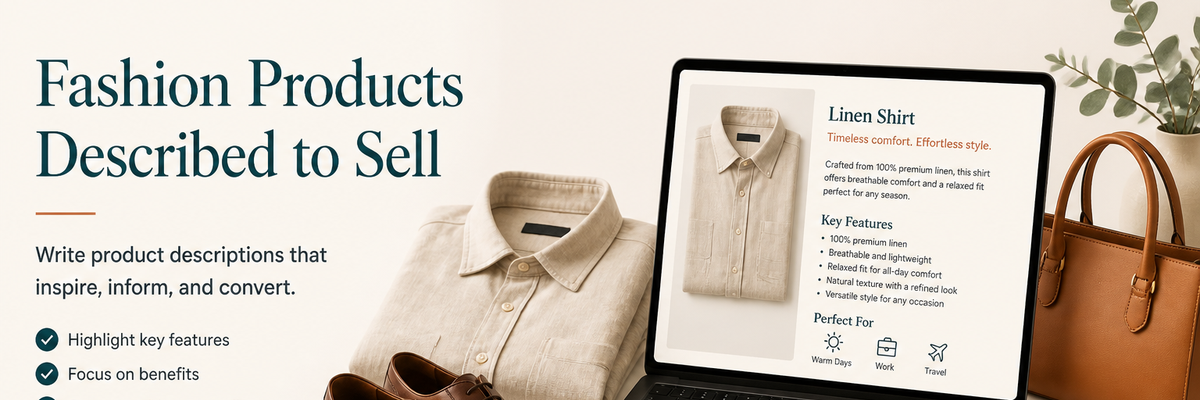
Fashion buying is driven by emotion, identity, and visual appeal as much as by function. A shopper comparing two black cotton t-shirts is not just weighing thread count — they are choosing which brand fits their self-image. Your description has to bridge that gap between what the product is and who the buyer wants to become when they wear it.
Consumer Psychology in Fashion Purchases
Research from McKinsey’s State of Fashion report consistently shows that online fashion shoppers cite product information quality as a top factor in purchase decisions, alongside price and imagery. When a description is vague, missing key details, or feels generic, the shopper assumes the product itself might be disappointing. Conversely, a description that demonstrates genuine understanding of the garment — its drape, its intended occasion, its care requirements — signals quality before the product even arrives.
Three psychological levers matter most in fashion copy:
- 1. Sensory language.Words like “buttery soft,” “structured,” “breathable,” and “weightless” help the shopper feel the fabric through text. Without a physical try-on, sensory words are the closest substitute.
- 2. Occasion framing.Telling a shopper where and when they would wear a piece — “weekday meetings that turn into evening dinners” — helps them project the product into their life.
- 3. Confidence through specificity. Vague claims like “high quality” erode trust. Specific facts — “garment-dyed for a lived-in fade,” “reinforced bartack stitching at stress points” — demonstrate that someone who knows clothing wrote the description.
Fashion Description Elements Checklist
Every fashion product description should cover these elements, though the emphasis shifts by category and platform:
| Element | What It Covers | Why It Matters |
|---|---|---|
| Material and fabric | Fiber content, weave, weight, texture | The #1 missing detail in fashion returns |
| Fit and silhouette | Cut, rise, length, intended fit | Reduces size-related returns |
| Occasion and styling | When and how to wear it | Helps the shopper visualize ownership |
| Care instructions | Wash, dry, iron guidance | Sets expectations, reduces complaints |
| Construction details | Stitching, closures, lining, hardware | Signals quality and justifies price |
| Sizing guidance | Model measurements, size chart link | The most common pre-purchase question |
Platform-Specific Adaptation
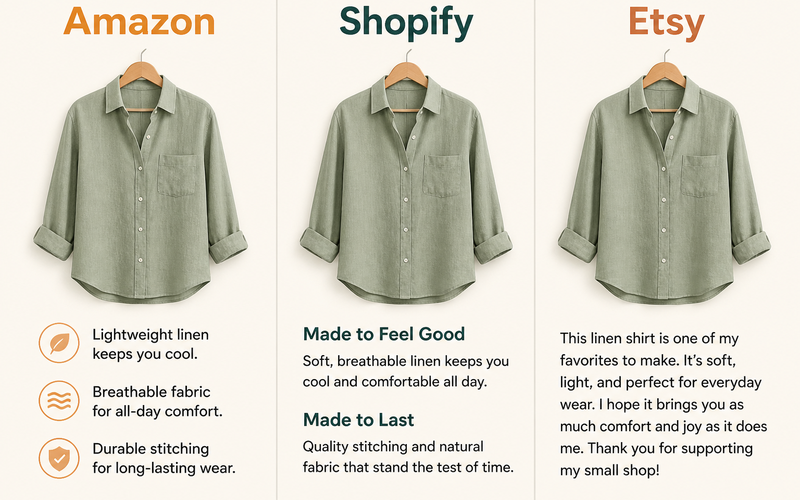
The core product information stays the same across marketplaces, but the format, length, and emphasis change. What works on Amazon will look sparse on Etsy, and what feels right on Shopify may get flagged on Amazon for keyword stuffing. Here is how to adapt a single fashion product description for the three major platforms.
Amazon Fashion Descriptions
Amazon rewards structure and discoverability. Your description feeds the search algorithm as much as it serves the human reader.
Title:Amazon allows up to 200 characters for fashion titles, but the first 60–80 characters carry the most weight for search. Lead with brand, then product type, then the most important attributes (color, material, fit). Example: “BrandName Women’s Merino Wool Sweater — V-Neck, Relaxed Fit, Charcoal Grey.”
Bullet points:You get five bullets. Each should lead with a benefit, then back it with a feature. Amazon’s A9 algorithm reads bullets for keywords, so include relevant search terms naturally — but never repeat the same phrase across bullets. For fashion, prioritize material, fit, occasion, care, and construction in that order.
Description text:Keep it under 2,000 characters. Use paragraphs, not walls of text. Avoid promotional language like “best-selling” or “#1 rated” — Amazon’s guidelines prohibit subjective superlatives. For deeper optimization, see our Amazon title optimization guide.
Backend keywords: Use the five backend search terms slots for synonyms and variations that do not fit naturally in the visible copy. Separate terms with spaces, not commas.
Shopify Fashion Descriptions
Shopify gives you full control over formatting, so you can create a richer experience than Amazon allows. But that freedom means you need to make deliberate choices.
Length and structure:Aim for 150–300 words of description text. Use subheadings (H2 or H3) to break it into scannable sections — “Why You’ll Love It,” “Fabric & Fit,” “How to Style.” Shoppers on a brand’s own site are already further along the funnel than Amazon browsers, so you can lead with story and emotion rather than keyword density.
Visual integration: Shopify lets you embed lifestyle imagery, video, size charts, and customer reviews directly in the description area. Use this. A fashion description on Shopify should pair text with at least one lifestyle photo showing the garment worn.
SEO:Shopify pulls your description into the page’s meta description by default. Write the first 155 characters as a self-contained summary. For platform-wide SEO strategy, refer to our Shopify SEO guide.
Etsy Fashion Descriptions
Etsy buyers shop for handmade, vintage, and unique items. The tone should feel personal and handmade even when you sell at scale.
Tone:Write conversationally, as if explaining the piece to a friend. First-person voice (“I sourced this linen from a mill in Portugal”) works well for maker-sellers. If you are a larger brand, use warm third-person but keep it human.
Tags and materials:Etsy’s search relies heavily on tags (13 available) and the materials field. List every fabric, component, and technique. “100% organic cotton, wooden buttons, French seams” gives Etsy’s algorithm more to match against.
Length: 100–250 words is typical. Lead with the story or inspiration, then cover the practical details. For more on Etsy-specific optimization, see our Etsy listing description guide.
How to Structure a Fashion Product Description
A strong fashion description follows a predictable flow: it hooks the reader, delivers the practical facts, and closes with an emotional reason to buy. Here is a structure that works across platforms, with the emphasis adjusted to fit each one.
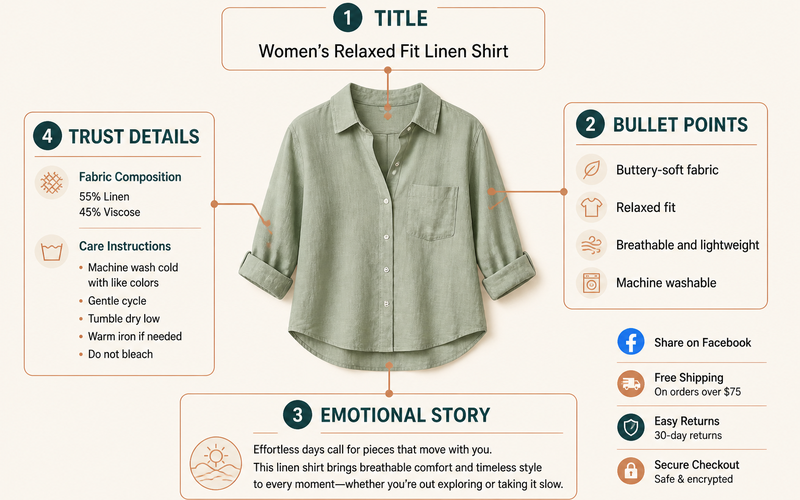
1. Title: Lead With the Product Type
The title is the first thing a shopper and a search engine see. Put the product type and the most important attribute first, then add supporting details.
Weak:“Beautiful Shirt for Women Available in Multiple Colors”
Good:“Women’s Relaxed Fit Linen Shirt — Short Sleeve, Sage Green”
The first tells the algorithm and the shopper exactly what the product is. The second wastes the most valuable real estate on an adjective. On Amazon, include brand name at the start. On Shopify, you can be more editorial — “The Sage Linen Shirt” — as long as the meta description and URL slug contain the searchable terms.
2. Bullet Points: Benefit First, Feature Second
Each bullet should start with what the shopper gains, then explain how the product delivers it.
- • Feel:“Buttery-soft against the skin — 100% French terry cotton with a brushed interior for warmth without bulk.”
- • Fit:“Relaxed through the body with a slightly cropped hem — designed to layer over high-waisted bottoms without bunching.”
- • Versatility:“Goes from morning coffee to evening walk — the weight works alone in spring or under a jacket in fall.”
- • Durability:“Holds its shape wash after wash — pre-shrunk fabric and reinforced ribbing at the cuffs and hem.”
- • Care:“Low-maintenance by design — machine wash cold, tumble dry low, no ironing needed.”
Notice that each bullet answers a shopper question: What does it feel like? How does it fit? When would I wear it? Will it last? How do I care for it?
3. Emotional Connection: The Lifestyle Paragraph
After the bullets, write one short paragraph that puts the garment into the shopper’s life. This is where fashion copy earns its keep.
“The Sage Linen Shirt is the one you reach for on a Saturday morning when the plan is nothing and everything. The fabric breathes in warm weather but has enough structure to look intentional, not sloppy. Roll the sleeves for a casual lunch, button them for a garden party. It does not demand attention — it earns it quietly.”
This paragraph should be 50–80 words. It does not need to mention every feature. Its job is to make the shopper feel the product in a moment.
4. Practical Details: The Trust Section
Close with the factual details that prevent returns and build trust: exact fabric composition, sizing notes, care instructions, and origin. Format these as a clean list or table, not as prose. Shoppers who have decided to buy will scan this section to confirm their choice. Shoppers who are undecided will use it to eliminate doubts.
Common Fashion Description Mistakes
Even experienced sellers fall into these traps. Each one suppresses conversions or increases returns.
1. Copying the Manufacturer’s Generic Description
Wholesale suppliers often provide a one-line description like “Women’s Cotton Blend Top.” If every seller on the platform uses the same text, your listing is invisible in search and indistinguishable from competitors. Rewrite every description in your own words, even if the product is identical.
2. Omitting Fabric Composition
Fabric content is the single most common missing detail in fashion returns. A shopper who receives a “soft blend” and discovers it is 100% polyester feels misled. State the exact composition: “55% linen, 45% cotton.” If you do not know, find out before listing.
3. Using Vague Sizing Language
“One size fits most” and “true to size” are meaningless without context. Provide model measurements (height, usual size, size worn in photo), a link to a size chart, and notes on intended fit: “Runs large — size down if between sizes.”
4. Stuffing Keywords Into Readable Copy
Amazon and Etsy both penalize listings that read like keyword lists. “Women’s fashion top fashion shirt fashion clothing fashion apparel” helps no one. Place keywords in titles, bullets, and backend fields where they belong, and keep the description readable.
5. Ignoring the Lifestyle Angle Entirely
A description that is only specs — “100% cotton, machine wash, imported” — gives the shopper no reason to want the product. Conversely, a description that is only lifestyle fluff — “embrace your inner goddess” — gives them no reason to trust it. Balance both.
Write Fashion Descriptions in Seconds
ImageChat’s Product Description Generator turns a product photo and a few details into a structured draft — title, bullets, lifestyle copy, and care instructions — ready for you to review and publish.
Generate Fashion Product DescriptionsFrequently Asked Questions
How long should a fashion product description be?
It depends on the platform. Amazon descriptions should stay under 2,000 characters. Shopify product pages typically use 150–300 words. Etsy listings range from 100–250 words. The goal is not length but completeness — every essential detail should be present without padding.
What keywords should I include in a fashion product description?
Include the product type (e.g., “linen shirt”), the category (e.g., “women’s tops”), material, fit, color, and occasion. Use tools like Google Keyword Planner or your platform’s search suggestions to find natural variations. Avoid forcing every variation into the visible copy — put extras in backend fields on Amazon or tags on Etsy.
Should I write different descriptions for each platform?
Yes. Even if the product is the same, the format, tone, and algorithm expectations differ. A single Amazon-style bullet list will look sparse on Shopify. A long Shopify lifestyle story will exceed Amazon’s character limits. Adapt the core information to each platform’s strengths.
How do I describe fabric if I cannot see or touch it?
Use sensory comparisons that shoppers already understand: “feels like a broken-in t-shirt,” “similar in weight to a dress shirt,” “the drape of a silk scarf.” Pair these with objective specs — GSM weight, fiber content — so the description is both relatable and precise.
Can AI write fashion product descriptions?
AI tools like ImageChat’s Product Description Generator can draft a complete description from a product photo or basic inputs. Use the output as a starting point, then edit for accuracy, tone, and platform fit. AI is fastest at producing the structural elements — bullets, material specs, care instructions — while human review ensures the emotional copy feels authentic.
How do I reduce returns through better descriptions?
Focus on fit and fabric. Provide model measurements, note whether the item runs large or small, state exact fabric composition, and include care instructions. Sizing issues and product expectations not matching the description are the top return drivers in online fashion. Precise descriptions address both.
Should I include care instructions in the description?
Always. Care instructions set expectations and reduce post-purchase complaints. State whether the item is machine washable, requires dry cleaning, or needs special handling. Format it as a simple list: “Machine wash cold, gentle cycle. Tumble dry low. Do not bleach.”
How often should I update fashion product descriptions?
Review descriptions quarterly and after any product change (new fabric supplier, updated fit, new colorway). Also update when you notice patterns in return reasons or customer questions — if multiple shoppers ask the same thing, the answer belongs in the description.
Generate Fashion Product Descriptions With ImageChat
Paste a product image, add the category and key attributes, and get a platform-ready description in seconds. Edit the tone, adjust the length, and fine-tune the emotional copy before it goes live.
Generate Fashion Product DescriptionsRelated Resources
- Product Description Generator — Create descriptions from product images
- Amazon Title Optimization Guide — Write Amazon titles that rank
- Shopify SEO Guide — Optimize your Shopify store for search
- Etsy Listing Description Guide — Write Etsy descriptions that convert
- Cross-Platform Listing Strategy — Manage listings across marketplaces
- SEO Metadata Generator — Generate titles, descriptions, and keywords
References
- Statista: Online Fashion Return Reasons — Data on why shoppers return fashion purchases online
- McKinsey: The State of Fashion — Annual industry report on consumer behavior and e-commerce trends