Why Beauty Descriptions Are Different
Beauty shoppers buy with both logic and emotion. They want to know the active ingredients and their concentrations, but they also want to feel that the product will make their skin look better, their confidence stronger, their routine simpler. A beauty description has to deliver scientific credibility and sensory aspiration in the same space — and do it within the strict regulatory environment that governs cosmetic claims.
Consumer Psychology in Beauty Purchases
Research from Statista shows that the global cosmetics e-commerce market is projected to reach over 130 billion U.S. dollars by 2026, with product information quality cited as a leading factor in purchase decisions alongside price and brand reputation. When a beauty description is vague — missing ingredient lists, skin type guidance, or texture cues — the shopper assumes the product might irritate their skin or simply not work. Conversely, a description that demonstrates real formulation knowledge signals that the brand stands behind its product.
Three psychological levers matter most in beauty copy:
- 1. Safety and trust. Beauty products go on the skin, near the eyes, on the lips. Shoppers need to feel confident that the formula is safe for their specific skin type. Clear ingredient lists, allergen callouts, and dermatologist-testing claims (when substantiated) reduce purchase anxiety.
- 2. Sensory language.Words like “weightless,” “silky,” “non-greasy,” “quick-absorbing,” and “fragrance-free” help the shopper imagine the texture and finish without trying it. In a category where feel is everything, sensory words are the digital equivalent of a tester.
- 3. Results framing. Shoppers buy beauty products to solve a problem — dryness, dullness, fine lines, acne. Descriptions that name the concern and explain how the formula addresses it convert better than those that list features without context.
Beauty Description Elements Checklist
Every beauty product description should cover these elements, though the emphasis shifts by category and platform:
| Element | What It Covers | Why It Matters |
|---|---|---|
| Key ingredients | Active ingredients, their function, and concentration if notable | The #1 detail beauty shoppers look for |
| Skin type suitability | Which skin types the product is formulated for | Prevents mismatched purchases and returns |
| Texture and finish | Consistency, absorption, finish (matte, dewy, natural) | Replaces the in-store tester experience |
| Shade and coverage | Shade names, coverage level, finish type | Critical for makeup products |
| Usage instructions | How and when to apply, how much to use | Sets expectations and improves results |
| Claims and certifications | Cruelty-free, vegan, fragrance-free, non-comedogenic | Builds trust and filters for specific needs |
Platform-Specific Adaptation
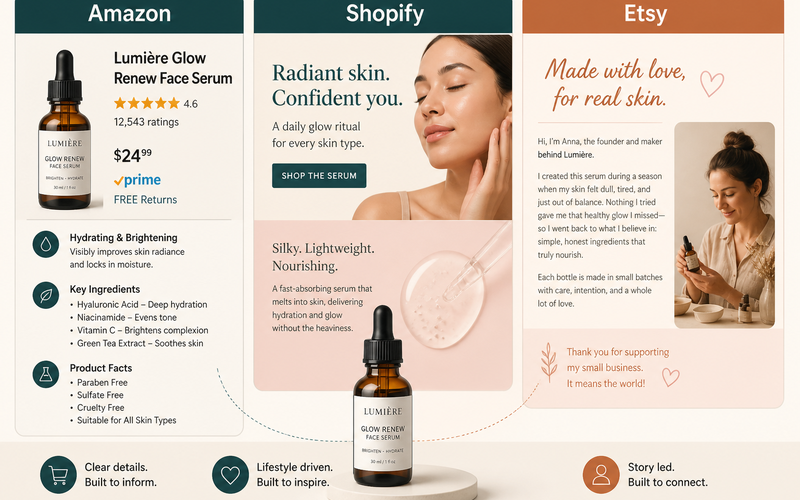
The core product information stays the same across marketplaces, but the format, length, and emphasis change. What works on Amazon will look sparse on Etsy, and what feels right on Shopify may violate Amazon’s claim restrictions. Here is how to adapt a single beauty product description for the three major platforms.
Amazon Beauty Descriptions
Amazon rewards structure and discoverability, but it also enforces strict guidelines on health and beauty claims. Your description must serve the search algorithm without crossing into prohibited territory.
Title:Amazon allows up to 200 characters for beauty titles, but the first 60–80 characters carry the most weight for search. Lead with brand, then product type, then key attributes (skin type, active ingredient, size). Example: “BrandName Vitamin C Serum — 20% L-Ascorbic Acid, for All Skin Types, 1 fl oz.” Avoid health claims like “cures acne” or “eliminates wrinkles” — Amazon prohibits therapeutic language for cosmetics.
Bullet points:You get five bullets. Each should lead with a benefit, then back it with an ingredient or formulation fact. Prioritize key ingredients, skin type suitability, texture and finish, usage, and certifications. Amazon’s A9 algorithm reads bullets for keywords, so include relevant search terms naturally — “brightening serum,” “anti-aging moisturizer,” “sensitive skin sunscreen” — but never repeat the same phrase across bullets.
Description text:Keep it under 2,000 characters. Use paragraphs, not walls of text. Avoid promotional language like “best-selling” or “miracle cure” — Amazon’s guidelines prohibit subjective superlatives and unsubstantiated claims. For deeper optimization, see our Amazon title optimization guide.
Backend keywords: Use the five backend search terms slots for synonyms and variations that do not fit naturally in the visible copy — ingredient synonyms, skin condition terms, alternative product names. Separate terms with spaces, not commas.
Shopify Beauty Descriptions
Shopify gives you full control over formatting, so you can create a richer, more brand-driven experience than Amazon allows. But that freedom means you need to make deliberate choices.
Length and structure:Aim for 200–400 words of description text. Use subheadings (H2 or H3) to break it into scannable sections — “Key Ingredients,” “Who It’s For,” “How to Use,” “The Results.” Shoppers on a brand’s own site are already further along the funnel than Amazon browsers, so you can lead with brand story and ingredient philosophy rather than keyword density.
Visual integration: Shopify lets you embed ingredient breakdowns, before-and-after imagery, texture close-ups, and customer reviews directly in the description area. Use this. A beauty description on Shopify should pair text with at least one texture or application photo showing the product in use.
SEO:Shopify pulls your description into the page’s meta description by default. Write the first 155 characters as a self-contained summary that includes the product type and key ingredient. For platform-wide SEO strategy, refer to our Shopify SEO guide.
Etsy Beauty Descriptions
Etsy buyers shop for handmade, natural, and small-batch beauty products. The tone should feel personal and transparent even when you sell at scale.
Tone:Write conversationally, as if explaining the formula to a friend. First-person voice (“I formulated this serum with cold-pressed rosehip oil from a sustainable farm in Chile”) works well for maker-brands. If you are a larger brand, use warm third-person but keep it human and ingredient-focused.
Tags and materials:Etsy’s search relies heavily on tags (13 available) and the materials field. List every ingredient, base, and technique. “Organic shea butter, cold-pressed jojoba oil, beeswax, vitamin E, essential oil blend” gives Etsy’s algorithm more to match against than “natural moisturizer.”
Length: 150–300 words is typical. Lead with the story or formulation philosophy, then cover the practical details — ingredients, skin type, usage, shelf life. For more on Etsy-specific optimization, see our Etsy listing description guide.
How to Structure a Beauty Product Description
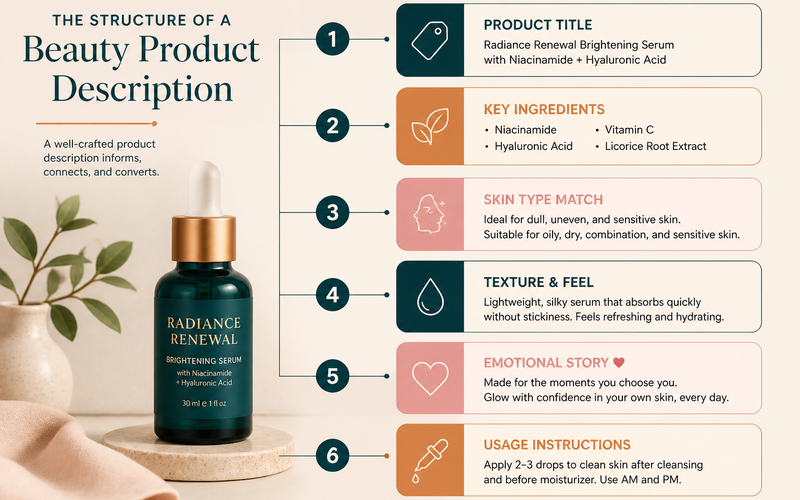
A strong beauty description follows a predictable flow: it identifies the product and its hero ingredient, explains who it is for, describes the sensory experience, and closes with usage instructions that set expectations. Here is a structure that works across platforms, with the emphasis adjusted to fit each one.
1. Title: Lead With the Product Type and Hero Ingredient
The title is the first thing a shopper and a search engine see. Put the product type and the most important ingredient or benefit first, then add supporting details.
Weak:“Amazing Serum for Glowing Skin”
Good:“Vitamin C Brightening Serum — 20% L-Ascorbic Acid, 1 fl oz”
The first tells the algorithm and the shopper exactly what the product is and what it does. The second wastes the most valuable real estate on a subjective adjective that Amazon would flag. On Amazon, include brand name at the start. On Shopify, you can be more editorial — “The Brightening Vitamin C Serum” — as long as the meta description and URL slug contain the searchable terms.
2. Bullet Points: Benefit First, Ingredient Second
Each bullet should start with what the shopper gains, then explain how the formula delivers it.
- • Brightens:“Visibly evens skin tone with 20% L-ascorbic acid — the purest, most studied form of vitamin C for brightening.”
- • Protects:“Antioxidant-rich formula neutralizes free radicals from UV and pollution — pairs with sunscreen for daytime defense.”
- • Suitable for all skin types:“Formulated at an effective but tolerable pH of 3.5 — gentle enough for sensitive skin when introduced gradually.”
- • Lightweight texture:“Water-based serum absorbs in seconds with no sticky residue — layers cleanly under moisturizer and makeup.”
- • Clean and conscious:“Fragrance-free, cruelty-free, vegan — no parabens, sulfates, or phthalates. Manufactured in small batches for freshness.”
Notice that each bullet answers a shopper question: What does it do? How does it protect me? Will it irritate my skin? What does it feel like? Is it safe and ethical?
3. Sensory and Emotional Connection: The Texture Paragraph
After the bullets, write one short paragraph that puts the product into the shopper’s routine. This is where beauty copy earns its keep.
“This is the serum you reach for on mornings when your skin looks tired and uneven. Three drops on clean skin, a gentle press with the fingertips, and it disappears — no tackiness, no waiting. Under moisturizer, it adds a quiet brightness that builds over weeks. On no-makeup days, it is enough on its own to make skin look awake.”
This paragraph should be 50–80 words. It does not need to mention every ingredient. Its job is to make the shopper feel the product in a moment.
4. Practical Details: The Trust Section
Close with the factual details that prevent returns and build trust: full ingredient list (INCI format if possible), skin type suitability, usage frequency, patch test recommendation, and storage guidance. Format these as a clean list or table, not as prose. Shoppers who have decided to buy will scan this section to confirm their choice. Shoppers who are undecided will use it to eliminate doubts.
Common Beauty Description Mistakes
Even experienced sellers fall into these traps. Each one suppresses conversions or increases returns.
1. Making Unsubstantiated Claims
Beauty is the most regulated e-commerce category when it comes to language. Claims like “cures acne,” “erases wrinkles,” “FDA-approved,” or “dermatologist recommended” (without proof) can get your listing removed on Amazon and expose your brand to legal risk. Stick to cosmetic claims — what the product does, not what it treats. “Visibly brightens” is acceptable; “treats hyperpigmentation” is not.
2. Omitting the Full Ingredient List
Beauty shoppers — especially those with sensitive skin, allergies, or specific ingredient preferences — read ingredient lists before buying. Hiding the INCI list or burying it behind a link signals that the brand has something to hide. Display the full list in the description or a clearly labeled section.
3. Ignoring Skin Type Guidance
A product that works beautifully for dry skin may cause breakouts on oily skin. Failing to state which skin types the formula is designed for leads to mismatched purchases, negative reviews, and returns. Be specific: “Formulated for normal to dry skin. Oily and acne-prone skin may prefer our lightweight gel moisturizer.”
4. Skipping Texture and Application Details
Online shoppers cannot feel the product. Descriptions that omit texture — “lightweight gel-cream,” “rich balm that melts into oil,” “watery essence” — leave the shopper guessing. Pair texture words with application guidance: “warm 2–3 drops between palms and press into damp skin.”
5. Using Generic Copy Across Products
If every product in your store has the same “luxurious formula, visible results” description, shoppers cannot tell products apart. Each description should highlight what makes that specific product unique — its hero ingredient, its texture, its place in a routine.
Write Beauty Descriptions in Seconds
ImageChat’s Product Description Generator turns a product photo and a few details into a structured draft — title, bullets, ingredient highlights, texture copy, and usage instructions — ready for you to review and publish.
Generate Beauty Product DescriptionsFrequently Asked Questions
How long should a beauty product description be?
It depends on the platform. Amazon descriptions should stay under 2,000 characters. Shopify product pages typically use 200–400 words. Etsy listings range from 150–300 words. The goal is not length but completeness — every essential detail (ingredients, skin type, texture, usage) should be present without padding.
What keywords should I include in a beauty product description?
Include the product type (e.g., “vitamin C serum”), the category (e.g., “face serum”), the hero ingredient, the skin type, and the primary benefit (e.g., “brightening,” “anti-aging”). Use tools like Google Keyword Planner or your platform’s search suggestions to find natural variations. Avoid forcing every variation into the visible copy — put extras in backend fields on Amazon or tags on Etsy.
Can I make health claims in beauty product descriptions?
No. Cosmetic products can claim to improve appearance (e.g., “visibly brightens,” “smooths the look of fine lines”) but cannot claim to treat, cure, or prevent medical conditions. “Reduces acne” implies a drug claim; “minimizes the appearance of blemishes” is a cosmetic claim. Always follow FDA guidelines and your platform’s policies.
Should I include the full INCI ingredient list?
Always. The INCI (International Nomenclature of Cosmetic Ingredients) list is the standard format for cosmetic ingredients and is expected by informed shoppers. Display it in the description or a clearly labeled section. Omitting it is one of the fastest ways to lose trust with ingredient-conscious buyers.
Can AI write beauty product descriptions?
AI tools like ImageChat’s Product Description Generator can draft a complete description from a product photo or basic inputs — title, bullets, ingredient highlights, texture paragraph, and usage instructions. Use the output as a starting point, then edit for accuracy, regulatory compliance, and brand tone. AI is fastest at producing the structural elements, while human review ensures claims are substantiated and ingredient lists are correct.
How do I describe texture if the shopper cannot feel the product?
Use comparisons shoppers already understand: “feels like a lightweight water gel,” “similar in richness to a night cream but absorbs faster,” “the consistency of a liquid serum, not a cream.” Pair these with application guidance so the shopper knows how much to use and how to apply it.
How do I reduce returns through better beauty descriptions?
Focus on skin type matching and texture expectations. State which skin types the product is for, note any contraindications (e.g., “not recommended for reactive skin”), provide clear usage instructions, and recommend a patch test. Product not matching the description is a top return driver in online beauty — precise descriptions address this directly.
How often should I update beauty product descriptions?
Review descriptions whenever you reformulate, change packaging, or add new shades. Also update when you notice patterns in return reasons or customer questions — if multiple shoppers ask whether a product is fragrance-free, that information belongs in the description, not buried in reviews.
Generate Beauty Product Descriptions With ImageChat
Paste a product image, add the category and key attributes, and get a platform-ready description in seconds. Edit the tone, adjust the length, and verify ingredient accuracy and claim compliance before it goes live.
Generate Beauty Product DescriptionsRelated Resources
- Product Description Generator — Create descriptions from product images
- Fashion Product Description Guide — Write clothing descriptions that convert
- Electronics Product Description Guide — Sell more tech with better descriptions
- Amazon Title Optimization Guide — Write Amazon titles that rank
- Shopify SEO Guide — Optimize your Shopify store for search
- Etsy Listing Description Guide — Write Etsy descriptions that convert
- SEO Metadata Generator — Generate titles, descriptions, and keywords
References
- FDA: Cosmetic Labeling Guide — Official guidance on cosmetic claims and labeling requirements
- Statista: Online Shopping Return Reasons — Data on why shoppers return online purchases
- Statista: Global Cosmetics E-commerce Market — Market size and growth projections for online beauty sales